
Which laws apply to your new hire?
Enter the job title, the pay, and the work location. In about two minutes you get every federal, state, and city rule that applies to that position, color-coded, with draft policy language your attorney can approve.
What a Screening Policy Report is
A Screening Policy Report is a written list of every law you must follow when you run a background check on one job position in one place. It also includes the policy wording to follow those laws.
Background check law is not one rulebook. The FCRA sits on top, then your state adds its own rules, and then your city or county may add more. The rules change with the job, the pay, and the work address. A Screening Policy Report sorts all of that out for one position, so you know what to ask, when to ask it, what records you may use, and which notices to send.
You tell us about the job
The title, the pay, the duties, and every city and state where the person will work. That takes about two minutes.
We compile the laws
Our engine pulls the federal, state, and local rules that apply to that exact position. Every rule is checked against statute text and cited.
You get the report
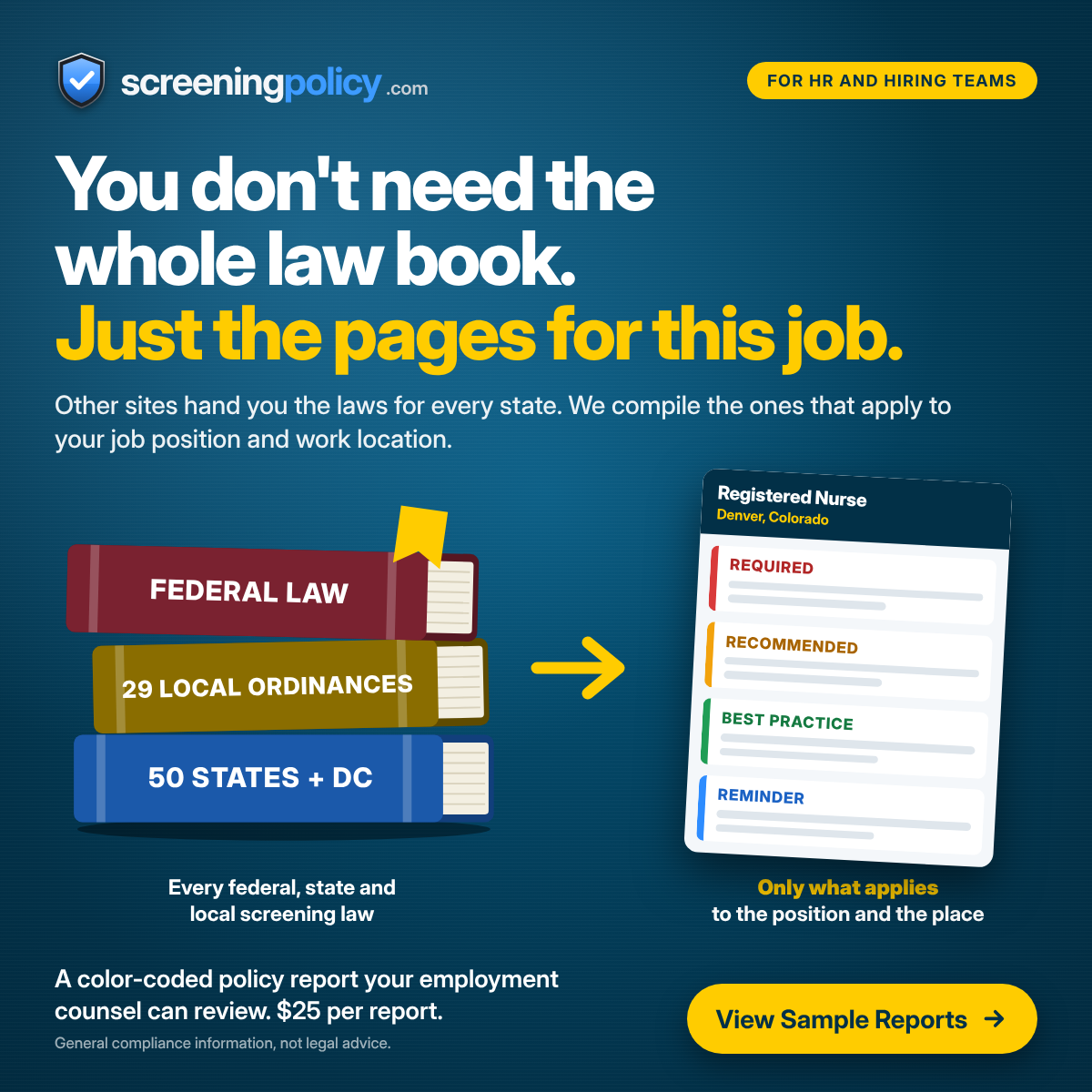
A color-coded list of required rules, recommended steps, and best practices, plus draft policy language. Hand it to your attorney to sign off.
We do the research. Your screening company runs the checks. Your attorney signs off. We are not a background check company, and we are not attorneys.
Same job title, different laws
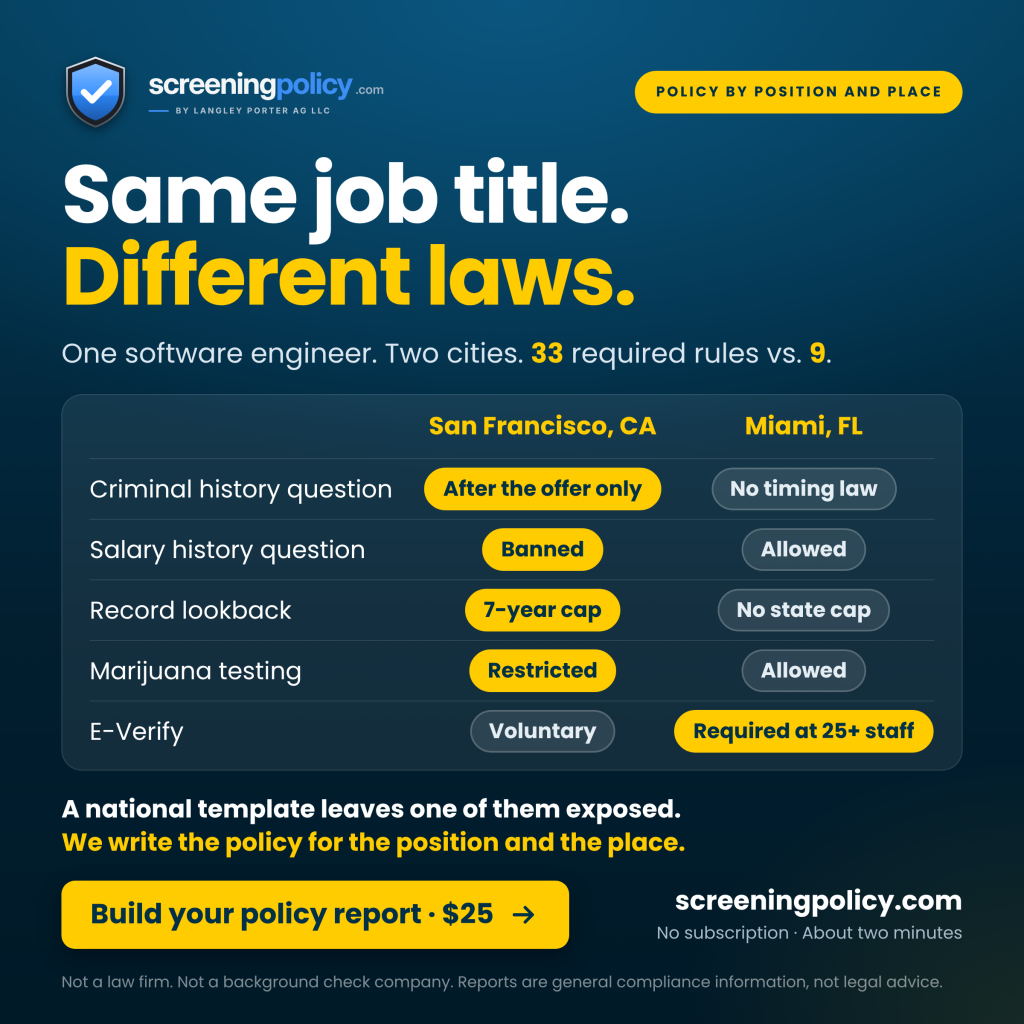
The laws for hiring a software engineer in San Francisco are not the laws for hiring one in Miami. One company answered our questions twice: same position, same $285,000 salary, same searches. Only the work location changed.
| Rule | Software engineer, San Francisco, CA | Software engineer, Miami, FL |
|---|---|---|
| Laws applied | Three layers: federal, California, and the City and County of San Francisco. | Two layers: federal and Florida. The law follows the place of work, so the California headquarters rules do not apply. |
| Ban the box | No criminal history question, search, or consideration until after a conditional offer (Gov. Code § 12952 and the San Francisco Fair Chance Ordinance). | No Florida ban-the-box law for private employers. Waiting for the offer is a best practice. Miami-Dade’s policy covers county government jobs only. |
| Records off limits | Arrests without conviction, diversions, dismissed or sealed convictions (Lab. Code § 432.7), marijuana convictions over two years old (§ 432.8), and in San Francisco, infractions and convictions over seven years old. | Sealed, expunged, and juvenile records. Arrests are not barred, but the report recommends caution under EEOC guidance. |
| How far back | Seven years, with no salary exception (Civ. Code § 1786.18), even at $285,000. | No state cap. At $75,000 or more, the FCRA seven-year limit on non-convictions is lifted. Seven years is a best practice. |
| Assessment and notices | A written individualized assessment is mandatory. Fair Chance Act notices come on top of the FCRA notices, with at least seven days to respond. | A written assessment is recommended, not required. Only the FCRA pre-adverse and adverse action notices apply, with a five-business-day wait. |
| Marijuana testing | Restricted. No adverse action for off-duty cannabis use or for non-psychoactive metabolites (Gov. Code § 12954). | Permitted. No applicable law restricts marijuana testing. |
| Salary history | Banned by California (Lab. Code § 432.3) and San Francisco. Job postings must show the pay scale. | No Florida law. The question is permitted, but the report does not recommend it. |
| E-Verify | Voluntary, and California restricts how it may be used. | Mandatory for private employers with 25 or more employees (Fla. Stat. § 448.095). |
| New state laws | 14 alerts on California employment laws signed in 2026. | None in the report. |
| Required changes | Six changes to the employer’s current process. | None required. Three improvements suggested. |
Same company, same job, same pay, same answers. A single national policy template leaves one of those two offices exposed. The report is written for the position and the place, not for the country.
Six screening mistakes that turn a hire into a lawsuit
Most hiring lawsuits do not challenge the hiring decision. They challenge the screening process around it. A Screening Policy Report closes each of these gaps before the first candidate is screened.
A disclosure buried in the application
The FCRA requires a clear, stand-alone disclosure before you order a report. Extra wording, such as a liability waiver, is a leading source of class actions.
15 U.S.C. § 1681b(b)(2)(A)
Asking about convictions too early
Fair-chance laws in many states and cities bar the conviction question on the application. Some also delay the check until after a conditional offer.
State and local ban-the-box laws
Skipping the pre-adverse action notice
Before you reject a candidate based on a report, you must send a copy of the report and a summary of rights, then give the candidate time to respond.
15 U.S.C. § 1681b(b)(3)
Using records the law puts off limits
Many states restrict arrests, sealed or expunged records, and older cases. A record you may use in one state can be barred in the next.
State lookback and record-use limits
Credit and salary questions where restricted
Several states and cities limit credit reports to specific positions. Many ban salary-history questions outright.
State credit-check and pay-equity laws
One national template for every location
Rules change by state, county, and city. A policy that works in Florida can break the law in California.
Federal, state, and local law stack
What a mistake can cost. Under the FCRA, willful noncompliance carries statutory damages of $100 to $1,000 per consumer, plus punitive damages and attorney’s fees (15 U.S.C. § 1681n). In a class action, that figure multiplies across every applicant you screened.
Four steps to your Screening Policy Report
The questions take about two minutes, and the preview is free. Use Back to correct any answer as you go. Once the preview appears, the answers behind it are final, so check them before the last step.
Describe the position
Enter the job title, pay, and duties, and whether the role drives, handles cash, or works with patients or children.
Add the work locations
Tell us the city, county, and state for every place the person will work, including remote workers.
Tell us how you screen today
Choose the searches, verifications, and tests you plan to run. Not sure? Pick “Not sure” and the engine recommends the proper due diligence for the position.
See the free preview, then unlock the report
Enter your name and work email to see how many rules apply, the jurisdictions behind them, and three rules in full. Unlock the complete report for $25.
What every Screening Policy Report contains
Every report opens with the three safeguards regulators look for first: a stand-alone disclosure, a signed authorization, and the same screening for every candidate in the same position. Then it works through the law for your position and locations.
FCRA process
Disclosure, authorization, pre-adverse and adverse-action notices, waiting periods, and the state notices that ride on top.
Criminal history rules
Ban-the-box timing, individualized assessments, arrests, sealed and expunged records, and lookback limits with salary thresholds.
Credit and salary history
Where credit reports are restricted, which exemption fits your position, and where salary-history questions and pay-range postings are regulated.
Drug testing and cannabis
Post-offer timing, written-policy requirements, marijuana and medical-cannabis protections, and DOT rules for regulated drivers.
E-Verify, exclusions, and industry checks
State E-Verify mandates, OIG and SAM screening, FACIS® Level 3 for healthcare, and fingerprint requirements for schools, care, and finance.
Draft policy language
A numbered policy for the position, ready for your letterhead and your counsel’s red pen.
Why counsel likes starting here
Writing a screening policy from scratch means hours of attorney research per position, and the research goes stale the next time a legislature meets. The report lists every applicable rule, cites the statute or ordinance, and names the agency that enforces it. Your lawyer reviews and signs off instead of researching and drafting.
What a report is not
It is not legal advice, and it does not replace your employment counsel. It is the research package that makes their review faster and their sign-off better informed. Every report carries the date its rules were current.
Built for the people who write and approve hiring policy
HR managers and recruiters
You know the position. The report tells you which questions to remove from the application, when to run the check, and which notices to send.
Staffing and PEO teams
You place the same job title in ten states. Run one report per state and position, then keep the strictest rule where locations overlap.
Employment lawyers and compliance officers
Start from a report that cites every statute, ordinance, and agency. Then sign off, edit, or push back with the citations in front of you.
Free preview, then $25 per report
A full Screening Policy Report is $25 and covers one position and its set of work locations. No subscription, no seat license, no minimum. The PDF is yours to keep and share with counsel.
Free preview first
See how many rules apply, which jurisdictions they come from, and three rules in full before you pay anything.
Instant report
After payment the full report opens on the same page. Print it or email the PDF to yourself and your reviewer.
No account to create
Your answers are not saved in our website’s database. We keep only your name, company, and email so that we can support you.
Need reports for several positions or locations? One payment buys up to 20 reports at $25 each. Already have an access code? Enter it on the Access Codes page.
Screening Policy Report questions
What is a Screening Policy Report?
It is a written list of every federal, state, and local law that governs a background check for one job position in one set of work locations, with draft policy language to follow those laws. You enter the position, pay, duties, and locations. The report returns the rules color-coded by priority, each with its citation.
Do you run background checks?
No. We hand you the policy to follow, and we recommend which searches to order. You order the checks from any screening company you choose.
Is the report legal advice?
No. The report is general compliance information prepared from the laws in effect on the date shown. It is designed to be reviewed and approved by your employment counsel, who remains responsible for the final policy.
How much does a report cost?
The preview is free. A full report costs $25 and covers one position and its work locations. There is no subscription or minimum purchase. One payment can cover up to 20 reports on the Access Codes page.
What does the free preview show?
It shows how many required, recommended, best-practice, and reminder items apply to your position, lists the jurisdictions behind them, and prints three of the rules in full. We ask for your name and work email before showing it. No card is needed.
Which laws does the report cover?
The federal Fair Credit Reporting Act, EEOC guidance, the ADA, DOT and FMCSA rules, E-Verify, and healthcare exclusion screening, plus the statutes of all 50 states and the District of Columbia and 29 city and county ordinances. It addresses ban the box, criminal-record use, lookback limits, credit reports, salary history, drug testing and cannabis, social-media privacy, and AI hiring laws. For California work locations it also adds alerts on newly signed state employment laws.
Why do a software engineer in San Francisco and one in Miami need different reports?
California and San Francisco delay the criminal history question until after a conditional offer, bar arrests and older convictions, cap reported records at seven years at any salary, restrict marijuana testing, and ban salary-history questions. Florida does none of those things for private employers, but it requires E-Verify for employers with 25 or more employees. The same job title gets 33 required rules in San Francisco and 9 in Miami.
Does the report cover remote employees?
Yes. Enter the location where each remote employee will actually work, and the report applies the state, county, and city law of that place. Your headquarters state is left out unless work is performed there. Where rules conflict, the report tells you to follow the strictest one.
Can I change my answers after I see the preview?
You can go back and correct any answer while you are filling in the questionnaire. Once the preview or the report is shown, its answers are final, because the report is built for exactly those facts. For a different position or location, start a new preview.
How current are the laws in the report?
The law set is verified against statute text and updated as legislatures act. Every report carries the date its rules were current. Run it again when the position, the location, or the law changes.
Do you store my answers or my report?
Your answers are not written to our website’s database. We keep your name and work email so that we can support you, and a copy of the report email comes to us when you email yourself the PDF. Your browser keeps your answers on your own device for up to seven days so that you can return to your preview.
Where do I enter an access code?
Go to the Access Codes page, type the code from your purchase or trial email, and the builder opens with the code applied. Each code is good for the number of reports shown in the email.
Get the Screening Policy Report for your next hire
Two minutes of questions. A free preview first. One cited, color-coded report for $25. A starting point your counsel can sign off on.
ScreeningPolicy.com is operated by Langley Porter AG LLC. Reports are general compliance information, not legal advice, and do not create an attorney-client relationship. Confirm every recommendation with your employment counsel before adopting a policy.